Open weights alone do not create an open market.
This was the second Foo Camp of the year. The June camp asked what sort of AI economy we want to create and which mechanisms might help it emerge. This one, Open Source and the Architecture of AI, started from market structure. A handful of firms are competing to dominate frontier AI and, in turn, to decide who may build on their systems, at what price and under what terms. Open source and distributed AI systems are a counterweight to that future.
The camp's background note asked how independent developers, companies, universities, public institutions and nations can use AI systems without becoming tenants of another proprietary layer of the stack. Open-weight models are increasingly competitive, but deploying them can still depend on concentrated cloud infrastructure, proprietary fine-tuning services, closed evaluation systems, or applications that control the user's tools, memory and accumulated context. Making openness usable and competitive also takes accessible compute, transparent data and training methods, reusable model harnesses and evaluations, portable context and memory, standardized telemetry and execution traces, identity and permissions for users and agents, and user agents that act for the user rather than for the platforms they encounter.
The Web, Linux and Apache were built from open components with stable interfaces, so outside developers could improve them, recombine them and capture value from them. Tim O'Reilly has called this an architecture of participation. The weekend asked what it would take to build one for AI, under three headings: from open models to open systems; a competitive, secure open AI market; and open infrastructure for agents. Under the last, the note asked what should be portable across AI applications, including tools, memory, identity, permissions, payments and execution history. Memory is the piece our prototype took on.
The Open Memory Protocol, running live.
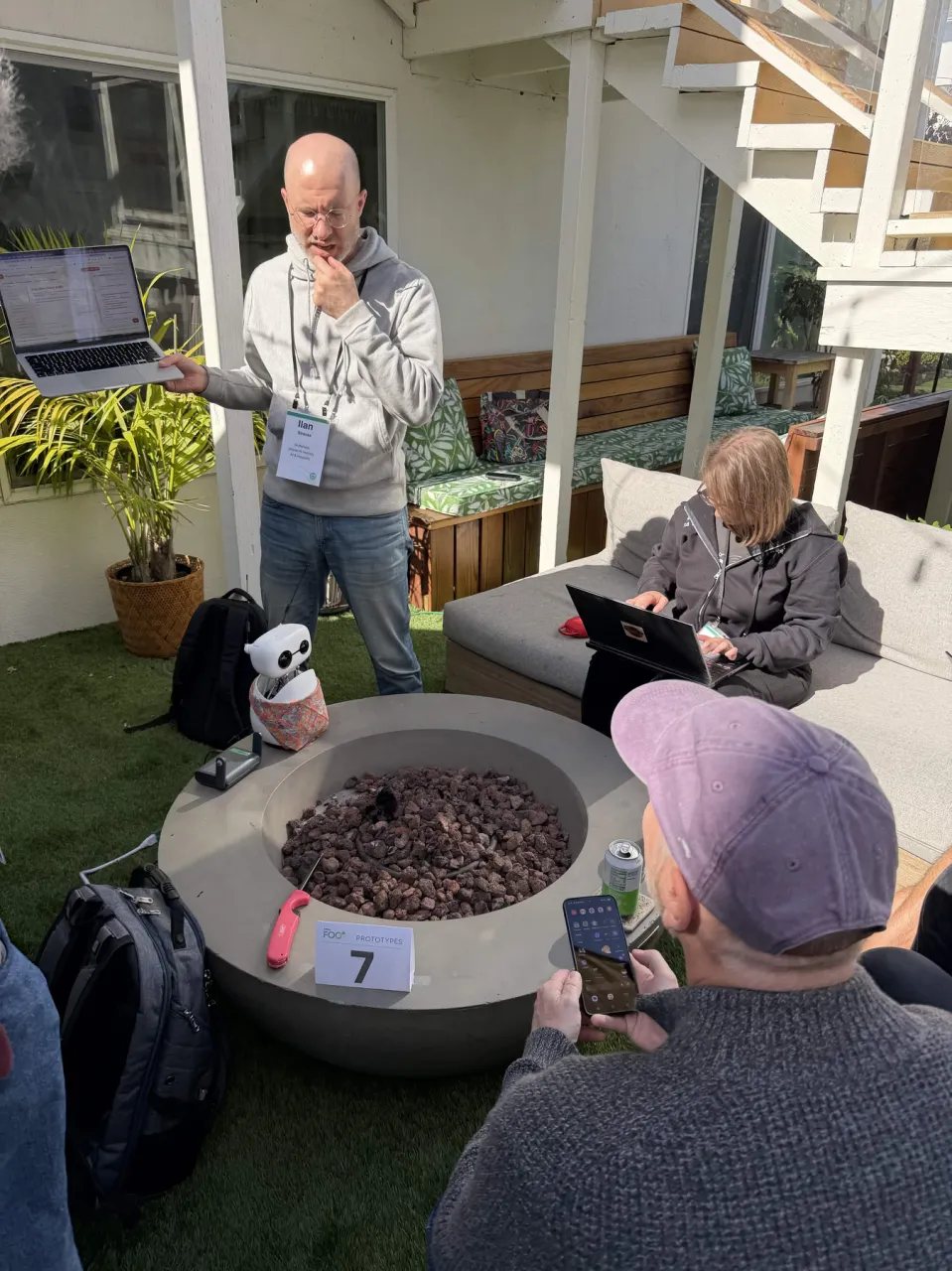
At the Sunday prototype track, new to this camp, we ran a live demo of the Open Memory Protocol (OMP). The AI Disclosures Project hosts the Open Memory Protocol Initiative, with Mozilla and IBM as co-hosts. The initiative is developing OMP as an open, royalty-free format for AI-agent memory, so that what an agent remembers, who said it, and what was forgotten can move between tools.
The demo covered the memory-object and runtime parts of the v0.2 editors' draft, the parts that make memory interoperable. One laptop ran three unrelated memory stores, each keeping memory its own way: Markdown files, a knowledge graph, and a full-text and embedding search index. They exchange memories in one shape, an OMP record per memory with its identifier, body, version, checksum and provenance, so a change in any store reaches the others without a converter for each pair. Every import leaves a receipt (accepted, transformed, conflict or rejected), and a forgotten memory travels as a tombstone, so out-of-date copies cannot bring it back.
Agents connect through an MCP server that works like any other. Ask the agent to save or read a memory and the server works against the search index, while OMP carries every upload or change through to the Markdown files and the knowledge graph. The demo also showed shared memory: one AI system shared a memory with Ola Hungerford's Reachy Mini robot.
Open Memory Protocol: Live Demo
One memory propagating across Markdown files, a knowledge graph and a search index, with agents connected over MCP.
Why do forecasts of AI's economic impact vary so widely?
Ilan Strauss and Markus Mobius (Microsoft Research) ran a session on why macroeconomic forecasts of AI's impact on jobs and productivity vary so widely, and on the need for a greater diversity of mental models of the economy: models that take new startups and firms, the distribution of income between capital and labor, and concentration seriously.
A blank session grid, and a new prototype track.
The format was the same as in June. There was no agenda until people arrived. On Friday night, attendees filled the session grid with the topics on their minds, and sessions ran all day Saturday, starting with an hour of lightning talks.
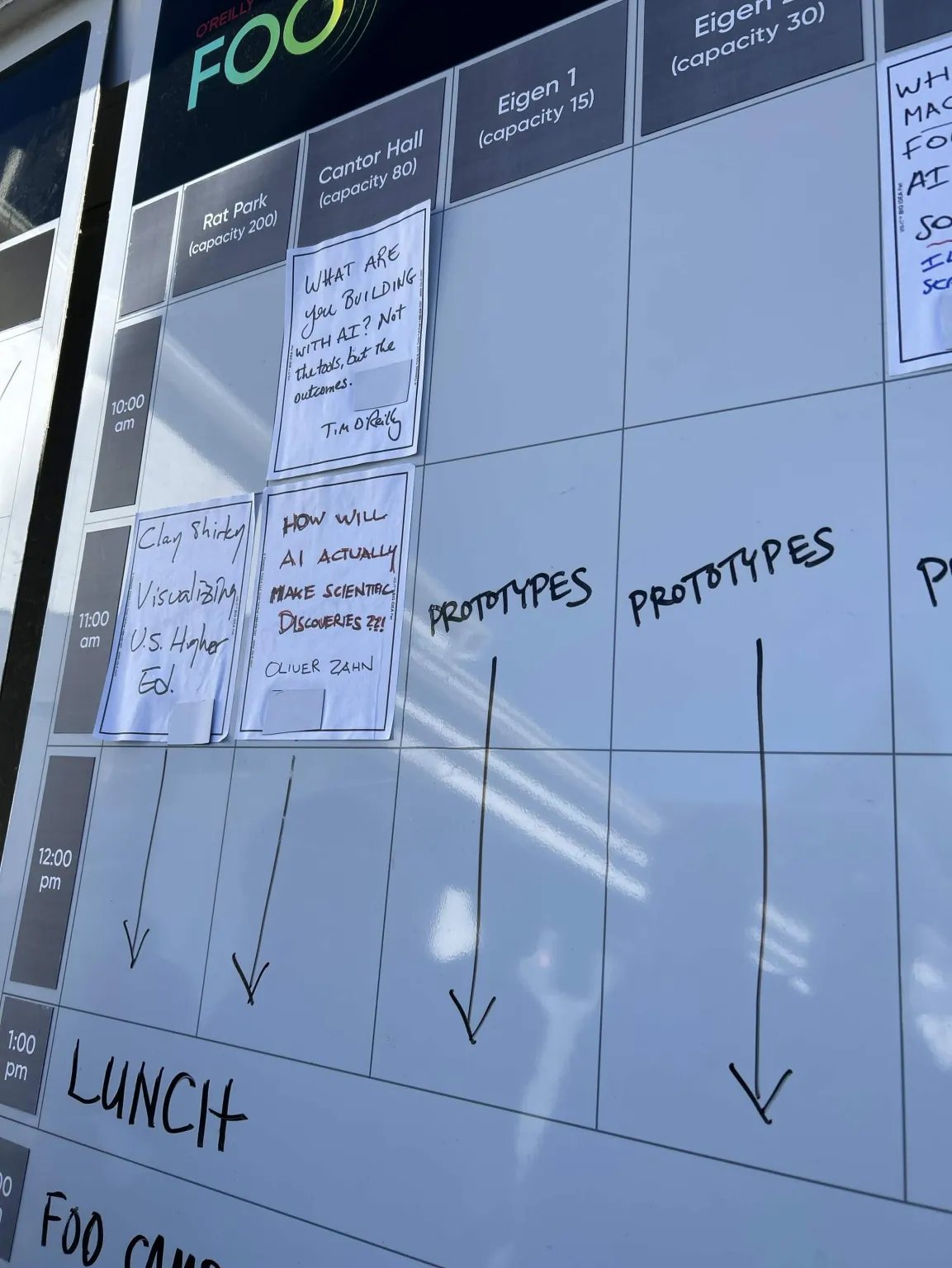
New this camp was a Sunday prototype track. For the two hours before lunch, prototypes ran as poster sessions, about a dozen at a time in each hour, and people moved between them every 15 minutes or so. Each one had to show something working within the first few minutes and explain why it matters.
This page is our slice of the weekend. Sunday morning's board alone also had Tim O'Reilly asking "What are you building with AI? Not the tools, but the outcomes," Clay Shirky visualizing U.S. higher education, and Oliver Zahn asking how AI will actually make scientific discoveries.
Friday, October 23
- 5:30 pmCheck-in
- 6:30 pmDinner
- 8:30 pmOpening session
Saturday, October 24
- 10:00 amLightning talks
- 11:00 am – 6:30 pmSessions
- 8:00 pmLast session of the day
Sunday, October 25
- 10:00 amSessions
- 11:00 am – 1:00 pmPrototypesNew
- 2:00 pmFoo Camp disbands